
If you tapped a beat on your table right now, I could string together a few eight counts worth of dance moves, easy peasy.
But ask me to freestyle rap over your makeshift boom bah dah dum dah dum and you’d be stifling a giggle. 🤭 I wouldn’t take it personally. Rapping is not my ministry.
I am, however, excellent at helping women own their talents with the full-throated bravura of a rapper.
Think Beyoncé¹saying that she’s one of one, Megan Thee Stallion saying she’s done being humble, or, to throw it back, Missy Elliott declaring she’s the hottest around.

Some might say they’re bragging, but I’d argue that they’re just stating facts.
As the rappers say, “It ain’t trickin’ if you got it.” And you, my friend, have got it. (By it, I mean facilitation skills.)
Plenty been said about the fact that women self-promote less than men². I’m not going to spell out the phenomenon or it’s underlying causes, which are often more societal than they are personal.
What I will do is give you a three-part processes for doing what’s in your control: communicating what you bring to the table as a facilitator. As we’ve established, facilitation is a multifaceted skillset that people don’t always get. All the more reason for you get comfortable talking about your craft.
How to communicate your facilitation craft
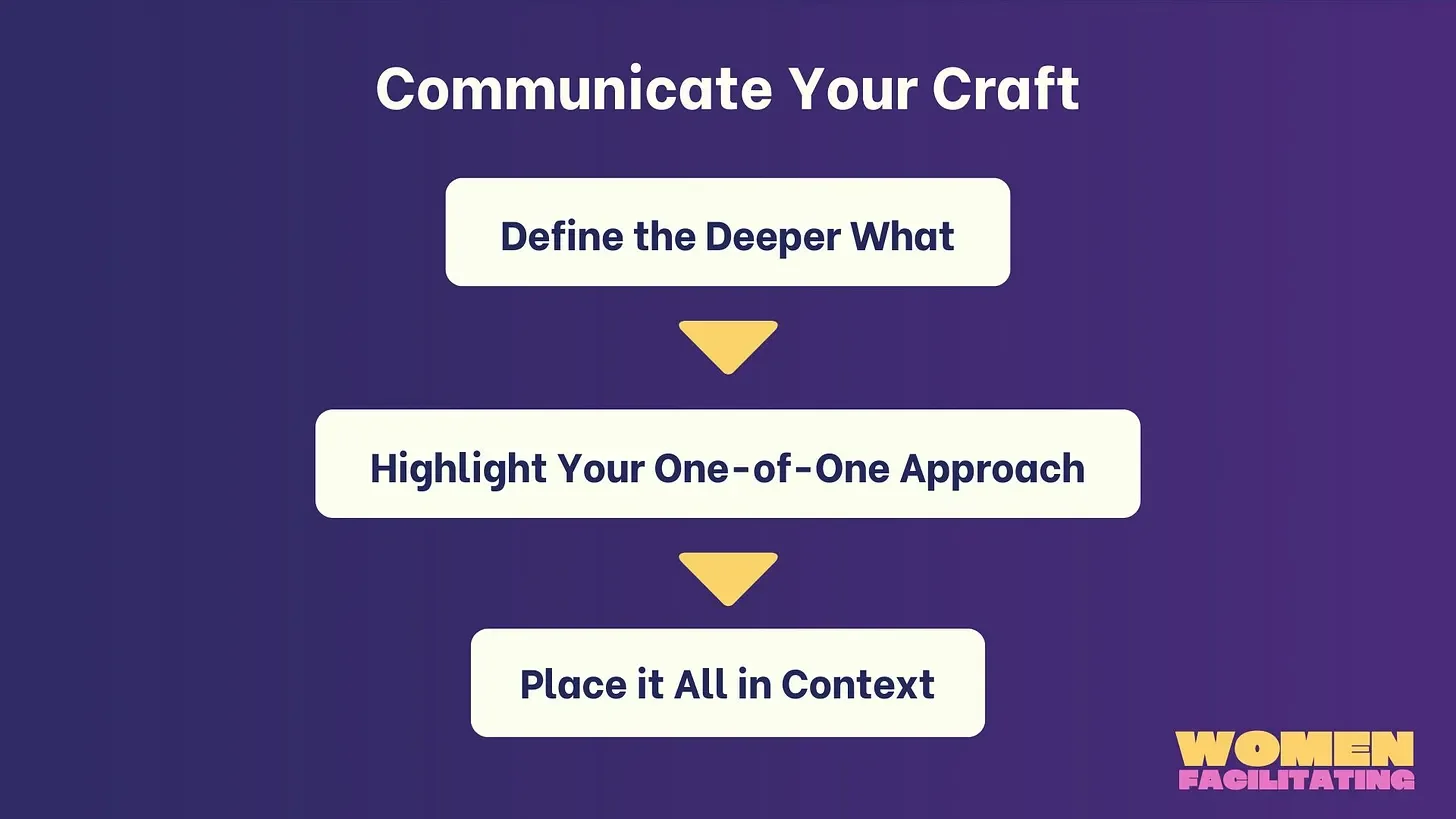
Define the deeper what
You’re good at asking the deeper questions. It’s what you do as a facilitator. Now I’m asking you to turn that skillset inwards.
Maybe your current introduction sounds something like this:
I facilitate team retreats.
I guide strategic planning meetings.
I lead professional development experiences.
Those aren’t bad starts by any means, but do those descriptions express the fullness of your work? Definitely not.
The tried-and-true Five Whys exercise comes in handy for adding depth to your description.
Why do you facilitate team retreats?
So teams can deepen their relationships.
That’s a start. Why do these deepened relationships matter?
Keep asking those questions, and you may get to something like, “I create spaces for teams to have the conversations that remove resource-sucking obstacles and foster connection. ”
It’s what you’ve been doing all along, but now you’re framing it in terms of the results you co-create with your clients.
Highlight your one-of-one approach
When you express the deeper what, people start to internalize the value of facilitation. They understand that facilitators aren’t just there to nod and take notes.
Now you’ve got another unspoken question to answer: Why you? What do you bring to this facilitation work?
This adrienne maree brown quote from Emergent Strategy comes to mind as I sit with that question:
There’s a conversation in the room that only these people at this moment can have. Find it.
Just as distinct conversations emerge depending on the mixture people and place, your strengths and style combine to create a value-filled approach that only you can bring. Find it.
We played around with different combinations of strengths based on our elements of facilitation and came up with four Facilitator Archetypes:
The Alchemist: Notices patterns to make meaning from complexity
The Architect: Gets to the why of the session and designs for that why
The Connector: Creates conditions for relationships to grow
The Navigator: Responds to needs of the room in real time
If we sat down for a gamestorming activity, I know we could come up with more archetypes. These archetypes aren’t all-encompassing, and they weren’t meant to be.
The goal is to help you own your strengths (and your growth edges) so you can more accurately talk about what you bring to the table.
You can find your archetype by taking this eight-question quiz. At the end, you’ll get a cute little summary of your natural strengths and next steps for growth.
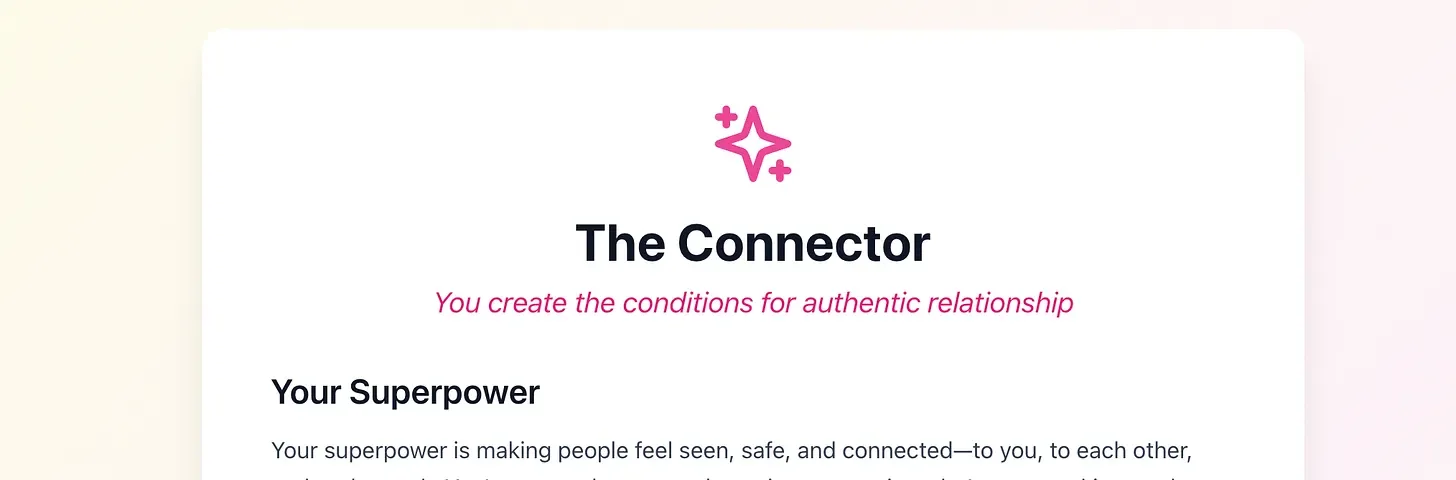
Take the facilitator archetype quiz here
Place it all in context
Based on the work you’ve done so far, communicating your craft might sound something like this:
I create spaces for teams to have the conversations that remove resource-sucking obstacles and foster connection. Clients often tell me that I have a knack for drawing out the thoughts that team members have left unspoken.
Honestly, if I were a manager whose team had been avoiding a gnarly conversation, I might hire you based on that description alone. Let’s go for the extra credit, though.
Connect what you’ve already shared to their context. You do this all.the.time when you’re facilitating. I’m just asking you to use a skill you already have in a different way. If they just went through a round of layoffs, you might mention how a facilitated experience can help rebuild psychological safety. If they’re gearing up for a make or break project, you could talk about how your work builds a winning team alignment.
Your next step
So there you have it:
Define the deeper what.
Highlight your one-of-one approach (Use our Facilitator Archetype quiz as a resource!)
Place it all in context.
Block some time on your calendar to work through this process, and let us know what you come up with in the comments!
1 - Yes, Beyoncé is a rapper. I don’t make the rules.
2- e.g., this working paper with a sample size of over 4,000.